
12 Mar A Professional’s Guide to Commercial Kitchen Flooring Options
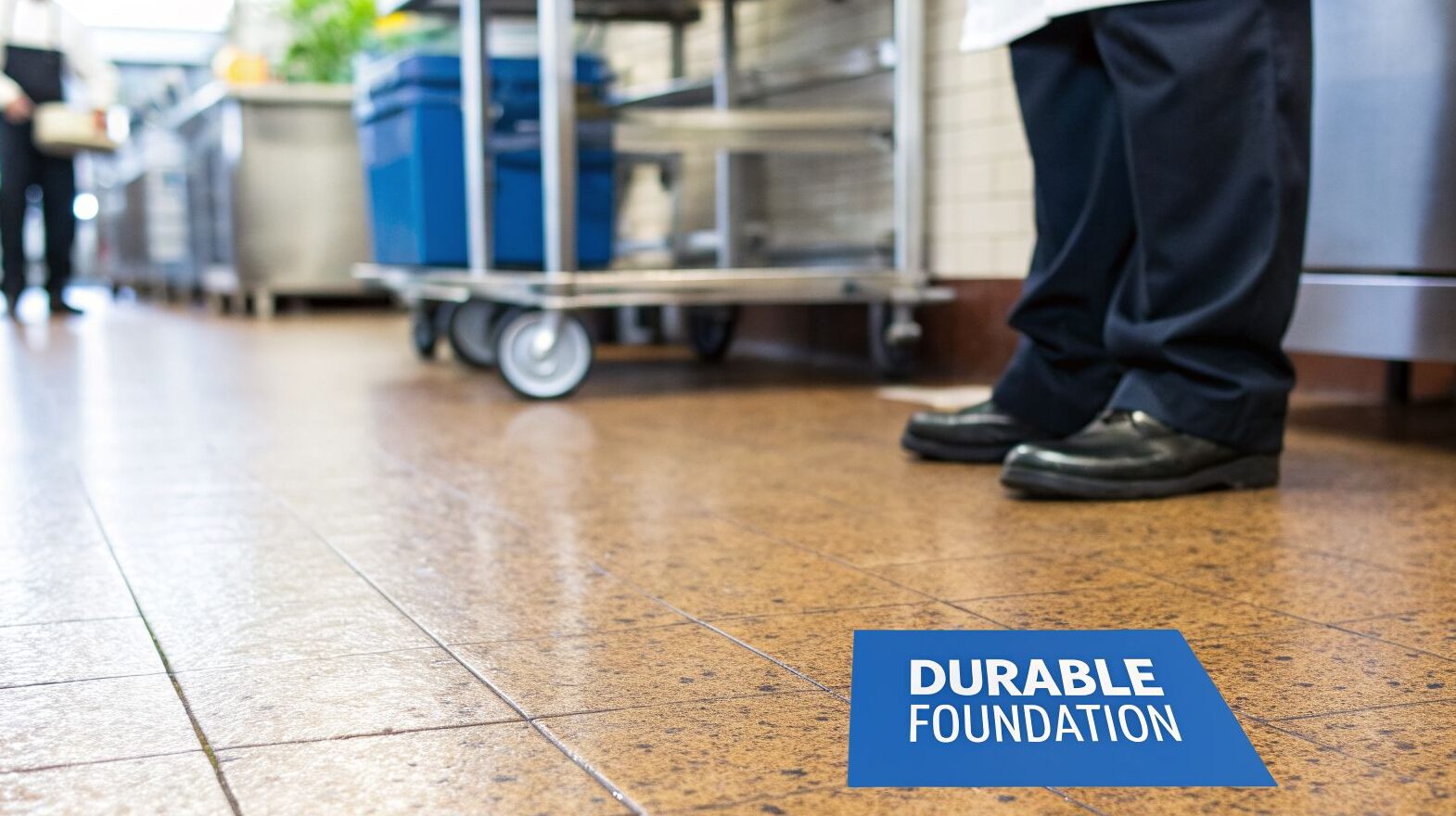
Your commercial kitchen floor is more than just a surface—it’s the foundation of your entire operation, directly impacting safety, hygiene, and profitability. Choosing the right flooring is like selecting tires for a race car; you need a solution engineered for extreme conditions, not a standard option that will fail under pressure.
Making an informed decision on commercial kitchen flooring options is a long-term investment in durability and operational excellence. Let’s explore how to select a floor that not only performs under the intense demands of a professional kitchen but also enhances your property’s value and aesthetic.
Why Your Kitchen’s Foundation Matters

The floor is the hardest-working surface in any food service business. Its condition dictates staff safety, operational efficiency, and your bottom line. A failing floor isn’t just an eyesore; it’s a liability that can lead to accidents, costly repairs, and even forced shutdowns by health inspectors.
Conversely, a high-performance floor is a true asset. It provides a safe, slip-resistant surface, stands up to the daily abuse of a professional environment, and simplifies cleaning and sanitation. This isn’t just an expense—it’s an investment in a safer, smoother, and more valuable operation, whether for a commercial kitchen, garage, or patio space.
What Defines a High-Performance Kitchen Floor?
A floor that thrives in a commercial kitchen must master several key challenges:
- Moisture Resistance: With daily wash-downs, constant spills, and steam, the floor must be 100% non-porous and waterproof to prevent moisture from seeping underneath and creating a breeding ground for mold and bacteria.
- Thermal Shock: The surface must withstand drastic temperature swings—from boiling water spills to cold-water hose-downs—without cracking, bubbling, or delaminating. Our systems are engineered for the local climate, handling temperature swings and UV exposure with ease.
- Chemical Resistance: From aggressive degreasers to acidic food spills like vinegar or tomato sauce, the surface must resist chemical damage that would degrade lesser materials.
- Heavy Traffic and Impact: It has to endure constant foot traffic, rolling carts, and dropped equipment without chipping, gouging, or showing wear.
A truly effective commercial kitchen floor is one you rarely have to think about. It performs its duties silently, protecting your staff and your business while allowing your team to focus on what they do best—creating exceptional food.
The Problem with Traditional Materials
For decades, the default choice was quarry tile. While seemingly tough, its weakness lies in the grout lines. Grout is porous, absorbing grease, moisture, and bacteria, making true sanitation impossible. Over time, it cracks and crumbles, creating a significant health and safety hazard.
This is why modern facilities are moving toward seamless flooring solutions. Systems like resinous coatings create a single, unbroken surface that is far more hygienic and durable. To see how seamless finishes compare to other options, you can learn more about polished concrete in our comprehensive guide.
This guide will break down the top commercial kitchen flooring options, providing the actionable insights you need to choose a floor that serves your business for the long haul.
Comparing Popular Kitchen Flooring Materials

Choosing the right floor for a commercial kitchen isn’t about looks; it’s about survivability. The real test is how a floor handles constant spills, heavy traffic, harsh chemicals, and extreme temperatures. Let’s compare the real-world performance of common options against modern, high-performance resinous floors.
H3: Quarry Tile: The Traditional Standard
Quarry tile has long been the industry default due to its initial toughness and heat resistance. However, its long-term performance is compromised by its greatest flaw: the grout.
The Grout Problem: Grout is inherently porous. It acts like a sponge, soaking up grease, oil, and wash water. This not only looks grimy but creates a prime breeding ground for bacteria, making it a constant struggle to meet health code standards.
Aggressive cleaning agents break down the grout, leading to cracks and chips that allow moisture to seep underneath. This causes tiles to loosen, creating dangerous trip hazards and requiring costly, kitchen-closing repairs.
H3: Vinyl Composition Tile (VCT) And Luxury Vinyl Tile (LVT)
Vinyl flooring often enters the conversation due to its low initial cost and variety of styles. Unfortunately, it is not engineered for a commercial kitchen environment and fails quickly.
- Vulnerability to Damage: As a soft material, vinyl is easily gouged by dropped utensils or dented by heavy equipment. Each imperfection becomes a trap for dirt and bacteria.
- Weak Seams: VCT and LVT consist of tiles or planks, creating a grid of seams that are vulnerable to moisture. Water inevitably gets trapped underneath, leading to curling edges, mold growth, and total floor failure.
- Poor Chemical and Heat Resistance: Harsh degreasers can strip vinyl’s finish, while hot oil or a dropped pan can melt or warp the material on contact.
The low upfront cost of vinyl is a classic false economy. Factoring in required maintenance and its short lifespan makes it one of the most expensive long-term choices.
H3: Polished Concrete: The Industrial Aesthetic
Polished concrete offers a clean, modern aesthetic and is an excellent choice for showrooms or retail spaces. However, in a commercial kitchen, its sleek look comes with significant drawbacks.
Its primary weakness is its vulnerability to acids. Common kitchen spills like vinegar, citrus juice, or tomato sauce can etch the surface if not cleaned immediately, leaving permanent dull spots. More importantly, polished concrete becomes extremely slippery when wet or greasy—a daily reality in any kitchen. Without specialized anti-slip treatments, it presents a major safety hazard.
H3: Resinous Coatings: Epoxy, Polyaspartic, and Urethane Cement
This brings us to modern resinous flooring systems. Engineered to solve the problems traditional floors can’t, these systems are fluid-applied directly over concrete, curing into a single, seamless, and rock-solid surface. This monolithic nature is their greatest advantage: no seams, no grout lines, and nowhere for bacteria to hide.
Key Advantages for Kitchens:
- Superior Hygiene: The non-porous surface is incredibly easy to clean and sanitize, making it easy to meet and exceed health codes.
- Exceptional Durability: These coatings form a powerful chemical bond with the concrete, creating a floor that withstands abrasion, impact, and spills from harsh cleaners and acidic foods.
- Customizable Slip Resistance: We broadcast aggregates like quartz or flakes directly into the coating to create a precisely textured, slip-resistant surface that provides excellent grip even when wet or greasy.
- Thermal Shock Resistance: Urethane cement, in particular, is designed to expand and contract with the concrete, allowing it to handle sudden temperature changes without cracking, peeling, or failing.
While the initial investment for a professionally installed resinous system is higher than for tile or VCT, its incredible lifespan, minimal maintenance, and superior safety and hygiene deliver the lowest long-term cost of ownership and significantly increase property value.
Flooring Performance at a Glance
This chart provides a clear side-by-side comparison of how these materials perform against critical kitchen metrics.
| Flooring Type | Hygiene (Seamless) | Slip Resistance | Chemical Resistance | Typical Downtime |
|---|---|---|---|---|
| Resinous Coatings | Excellent | Excellent (Customizable) | Excellent | 1-2 Days |
| Quarry Tile | Poor | Fair | Good | 5-7+ Days |
| Vinyl (VCT/LVT) | Poor | Poor | Poor | 2-3 Days |
| Polished Concrete | Good | Poor (When Wet) | Fair | 3-5 Days |
As the table shows, resinous coatings are the only option delivering top-tier performance across all categories, from hygiene to safety.
Why Resinous Coatings Are the Modern Standard

The shift away from traditional materials like quarry tile is driven by the need for truly hygienic, high-performance floors. Modern resinous systems like epoxy and polyaspartic coatings are not just floor coverings; they are liquid-applied shields that bond with the concrete to eliminate every crack, seam, and grout line where contaminants hide.
This trend toward superior flooring solutions is a key reason the global commercial kitchen flooring market is valued at over $2.1 billion as of 2026. Learn more about this growing demand in this comprehensive market analysis.
The ‘Pristine Process’: Technical Excellence Starts with Preparation
A high-performance floor’s longevity is determined by the quality of the concrete preparation. This non-negotiable step, central to the ‘Pristine Process’, separates a professional installation from one that will peel and fail.
It begins with heavy-duty mechanical grinding. We use industrial diamond grinders to open the concrete’s pores, creating a rough profile that allows the base coat to achieve a powerful mechanical bond. This is far superior to ineffective shortcuts like acid etching.
Think of it like this: you wouldn’t paint over rust and expect a perfect finish. Proper surface preparation is the single most important factor in a floor coating’s long-term performance.
After grinding, we meticulously repair every crack, spall, or pit. This ensures the final surface is perfectly flat and stable, preventing old issues from compromising the new floor.
The Power of an Industrial-Grade, Multi-Layer System
With a properly prepared slab, we build the system layer by layer. We begin with a thick, 100% solids epoxy base coat. This isn’t a thin primer; it’s a robust moisture barrier that seals the concrete and stops hydrostatic pressure from below. We do not skimp on this critical foundation.
Next, we broadcast a full spread of your chosen decorative flakes or quartz aggregate. This is a crucial step that builds the floor’s thickness, impact resistance, and aesthetic appeal.
The final layer is a Polyaspartic topcoat, which offers significant chemical advantages over older, epoxy-only floors.
- Exceptional Durability: Polyaspartic coatings offer incredible chemical and abrasion resistance, standing up to the harshest degreasers and acidic spills.
- UV Stability: Unlike epoxy, which yellows with sun exposure, polyaspartics are 100% UV stable. Your floor’s color will remain true, even in kitchens with windows—perfect for our local climate’s high UV exposure.
- Rapid, 1-Day Installation: Polyaspartics cure extremely quickly, allowing for a full 1-day installation. This minimizes downtime for your business.
To understand the superior chemistry, you can learn more about the science behind polyaspartic floor coatings. We offer a range of decorative options, including our popular flake, quartz, and solid color systems.
Designing for a Deeper Clean
A truly hygienic floor addresses all weak points, including where the floor meets the wall. This 90-degree corner is notoriously difficult to clean.
That’s why we integrate seamless cove bases into our systems. We curve the flooring material 4 to 6 inches up the wall, creating a smooth, bathtub-like edge. This eliminates the hard-to-clean corner, making sanitation faster and far more effective. It’s how you go from meeting health codes to setting a new standard of clean.
Meeting Health and Safety Codes with Confidence
A visit from the health inspector shouldn’t be a source of anxiety. Choosing the right commercial kitchen flooring options from the start builds compliance directly into your operation’s foundation. Health department and FDA regulations prioritize hygiene and safety, making your flooring a critical decision.
At its core, the health code is about one thing: stopping pathogens in their tracks. Your floor must be non-porous, a breeze to sanitize, and completely free of cracks or seams where bacteria, moisture, and food scraps love to hide.
This is precisely why old-school quarry tile becomes a sanitation liability. Its porous grout lines are a natural haven for contaminants. A seamless resinous floor, by contrast, creates a single, solid surface with nowhere for germs to go.
Key Compliance Factors for Kitchen Flooring
To pass inspection with confidence, your floor must deliver on three critical fronts:
- Surface Porosity and Cleanability: The floor must be absolutely watertight and non-porous so it won’t absorb grease, oil, or water. This makes daily cleanup fast and effective.
- Slip Resistance: Staff safety is paramount. We engineer our floors with integrated aggregates to create a textured finish that provides solid footing even when wet, meeting safety standards without compromising cleanability.
- Indoor Air Quality: The materials used should not compromise air quality. We use modern, industrial-grade systems formulated with low or zero Volatile Organic Compounds (VOCs), ensuring a healthy environment during and long after installation.
Sustainability and Modern Building Standards
The demand for healthier, more sustainable building materials is growing. This shift influences new regulations and is driving the entire commercial flooring market forward. To learn more, you can explore the latest research on the commercial flooring market.
Choosing a low-VOC, durable flooring system is about future-proofing your business. It aligns with responsible building practices and represents a smart investment that will deliver value for years. A floor designed for compliance from day one becomes one of your kitchen’s strongest assets.
The Installation Process & Long-Term Value
When evaluating new commercial kitchen flooring, the installation process—and the associated downtime—is a massive piece of the puzzle. For any working kitchen, downtime is lost revenue.
Traditional options like quarry tile can shut down your kitchen for a week or more. In contrast, modern Polyaspartic coating systems are designed for a rapid return to service. A professional crew can often complete the entire installation, from prep to final topcoat, in as little as one day.
A Process Built on Excellence, Not Shortcuts
A new coating is only as good as its bond to the concrete. This requires a meticulous, step-by-step process.
First is aggressive surface preparation. We use industrial-grade diamond grinders to remove old flooring and create a coarse, porous texture. This allows the base coat to achieve a powerful mechanical bond that is impossible with shortcuts.
Next, we repair every imperfection, filling cracks, pits, and spalls with a high-strength mender. This creates a perfectly smooth, stable foundation, ensuring old problems don’t telegraph through your new floor.
Building a Floor Layer by Layer
Once the concrete is perfectly prepped, we apply a thick, moisture-blocking epoxy base coat. This critical first layer seals the concrete and prevents moisture vapor transmission—a common cause of coating failure. We do not skimp here; a substantial base coat is key to a long-lasting floor.
The final layer is the polyaspartic topcoat, which provides superior performance. This industrial-grade material is incredibly tough, resisting scrapes, impacts, and harsh chemicals. It is also 100% UV stable, so it won’t yellow or fade, even in spaces with natural sunlight.
A professional installation transforms your floor from a liability into a reliable asset. It’s an upfront investment that pays dividends through decades of safety, hygiene, and durability, allowing you to focus on your business, not your floors.
Maintenance That’s Actually Simple
One of the greatest practical benefits of a seamless, non-porous floor is its ease of maintenance. Grease, grime, and spills sit on the surface and cannot soak in, making daily cleanup fast and effective.
Maintenance Tip: Keep your floor in pristine condition with a simple routine. Sweep daily to remove loose debris. Mop as needed with a pH-neutral cleaner mixed with water to sanitize the floor without leaving residue or harming the topcoat. Wipe up spills as they happen.
This simple approach saves significant time and labor, proving the long-term value and protection of a quality installation.
Your Commercial Kitchen Flooring Checklist
Choosing your kitchen floor is a decision that impacts your business for years. The right choice leads to a safer, cleaner, and more efficient operation. This checklist will help you identify your needs and make an informed decision.
Homeowner & Business Owner Concrete Evaluation Checklist
Use this checklist to evaluate your current concrete floor, whether in a kitchen, garage, or on a patio:
- [ ] What is the current condition? Note any visible cracks, pits, or spalling (flaking). Are there old coatings that are peeling or failing?
- [ ] Are there moisture issues? Do you see damp spots or white, powdery residue (efflorescence)?
- [ ] What is the floor exposed to? Consider vehicle traffic, chemical spills (oil, salt), UV exposure, and foot traffic.
- [ ] What is the primary goal? Are you looking for durability, improved aesthetics, easier cleaning, or increased property value?
Questions to Ask Before You Decide
- What’s your real-world traffic? Be realistic about the daily beating your floor will take from foot traffic, rolling carts, and equipment.
- What chemicals are you really using? List all degreasers, sanitizers, and potential acidic spills like vinaigrette or hot sauce.
- Where are your wet zones? Identify areas with constant moisture, such as dish pits, prep stations, and ice machines.
- How much downtime can you actually afford? Every hour closed is lost revenue. Do you need a 1-day installation or can you afford to be closed for a week?
For most busy kitchens, these questions point directly to a high-performance polyaspartic coating system. It provides a seamless, durable surface that handles intense traffic and chemicals, with the game-changing benefit of a one-day installation.
This decision tree highlights the importance of installation time.

If minimizing downtime is critical, modern coating systems offer a massive advantage over traditional options.
Actionable Insight: Before contacting a professional, document your current floor’s failures. Take photos of cracked grout, stains, pooling water, and worn traffic paths. This “evidence file” provides a flooring expert with the exact problems they need to solve permanently.
Now you’re prepared to make an informed investment in a system that will protect your staff, ace health inspections, and support your business for years to come.
Your Kitchen Flooring Questions, Answered
Choosing a new floor shouldn’t be stressful. Here are straightforward answers to common concerns from restaurant owners and facility managers.
“Can it be applied to damaged concrete?”
Absolutely. In fact, repairing damaged concrete is a core part of our ‘Pristine Process’. A high-performance coating is only as good as its foundation.
We begin with industrial diamond grinding to remove old, failing coatings and create a clean slate. Then, we meticulously repair every crack, pit, and spalled area with high-strength menders. We only proceed once we have a perfectly smooth and stable surface ready for bonding. Your old, damaged concrete becomes the perfect substrate for a new, durable floor.
“How long does it take?”
We know that for any business, downtime is lost revenue. This is where our systems offer a significant advantage over traditional flooring like tile, which can take a week or more to install.
Our Polyaspartic systems are designed for a rapid return to service. Thanks to their fast-curing properties, a full installation—from surface preparation to the final topcoat—can often be completed in just one day. The floor is typically ready for light foot traffic in a few hours and a full return to service within 24-48 hours.
“What is the maintenance like?”
This is one of the best practical benefits. Maintaining a seamless, non-porous floor is incredibly simple and cost-effective. Grease, oil, and food spills cannot penetrate the surface, preventing stains and odors.
Forget the nightmare of scrubbing grout lines. Daily sweeping and mopping with a pH-neutral cleaner are all that’s required to keep your floor sanitary and looking pristine. You will save a tremendous amount of time and labor on daily cleaning.
Ready to invest in a floor that provides long-term protection, durability, and aesthetic value? The team at Pristine Epoxy Floor Coatings is here to provide a professional consultation and build the right system for your kitchen, garage, or commercial space. Contact us today for a free, no-obligation estimate.