08 Mar What is polyaspartic floor coating: A Guide to Ultimate Concrete Protection
You’re hearing about polyaspartic floor coatings and wondering if they’re just another industry buzzword. Let’s clear the air. A polyaspartic coating isn’t paint, and it’s not a slightly better epoxy. It’s a distinct class of high-performance flooring technology engineered for long-term protection, durability, and aesthetic value.
Think of it this way: you wouldn’t put regular car tires on a race car. A polyaspartic system is the high-performance radial tire for your floor—built for extreme durability, a stunning finish, and a rapid, one-day installation that gets you back to your life with minimal disruption.
The Ultimate Shield for Your Concrete
Forget the flimsy floor paints from big-box stores. A true polyaspartic floor is an industrial-grade system engineered for strength. It’s designed to chemically bond with your concrete, creating a seamless, non-porous surface that protects it from virtually anything life throws at it.
This isn’t a new, unproven gimmick. It’s a battle-tested technology with serious industrial roots, ensuring it delivers on its promise of long-term protection.
A Technology Born from Industry
Polyaspartic chemistry wasn’t invented for pretty garage floors. It was first developed by Bayer Material Science in the early 1990s as a super-tough, anti-corrosion coating for steel bridges and other heavy-duty infrastructure. Its job was to withstand extreme weather, salt, and constant abuse.
It didn’t take long for flooring experts to see the potential. By the mid-90s, the formula was adapted for concrete, bringing that same industrial-strength resilience to high-traffic commercial and residential floors. That history matters. It tells you this material was born to perform under pressure. You can discover the full history of this innovative coating technology and see how it evolved.
What Makes Polyaspartic a Superior System
A professional polyaspartic installation is far more than just the topcoat. It’s a complete system designed from the ground up to transform your concrete. Here’s what makes it stand out:
- Incredible Durability: The chemistry creates a dense, hard-wearing surface that’s also flexible. It won’t chip from dropped tools and easily resists hot tire pickup, abrasions, and heavy foot traffic.
- True UV Stability: Standard epoxy yellows and breaks down in the sun. Polyaspartic topcoats, on the other hand, are 100% UV stable. This is a game-changer for garages, patios, and any space exposed to our local climate’s year-round UV exposure.
- Rapid One-Day Installation: This is perhaps its biggest advantage for homeowners. Because polyaspartics cure so quickly, our professional crews can prep your floor, apply the full system, and have it ready for you in just one day. No waiting around for days on end.
To give you a clearer picture, here’s a quick rundown of what makes polyaspartic coatings a premier choice for long-term value.
Polyaspartic Coating at a Glance
| Characteristic | Performance Overview |
|---|---|
| Cure Time | Extremely fast; full system installed in one day. |
| Durability | High resistance to abrasion, impact, and hot tire pickup. |
| UV Stability | 100% UV stable; will not yellow or fade in sunlight. |
| Flexibility | More flexible than epoxy, resisting chips and cracks. |
| Chemical Resistance | Protects against oil, gas, salt, and common household chemicals. |
| Low VOCs | Lower odor during application compared to many other systems. |
| Ideal Use Cases | Garages, patios, walkways, commercial spaces, and industrial floors. |
This table highlights why so many homeowners and businesses are choosing polyaspartic—it simply outperforms older technologies in the areas that matter most for durability and aesthetic value.
Maintenance Tip: Keeping your new floor looking sharp is easy. A quick sweep with a dust mop handles daily debris. For a deeper clean, just use a pH-neutral cleaner and a microfiber mop. You can ditch the harsh, acidic chemicals—they’re not needed and can dull the finish over time.
It’s crucial to understand that a real polyaspartic system isn’t just poured over your old concrete. The magic starts with the Pristine Process—our mandatory diamond grinding preparation. This step opens up the pores of the concrete, creating a bulletproof mechanical bond that ensures your floor will never peel or delaminate. It’s how we deliver a beautiful, resilient floor that adds serious function and value for decades to come.
How We Build a Floor That Actually Lasts
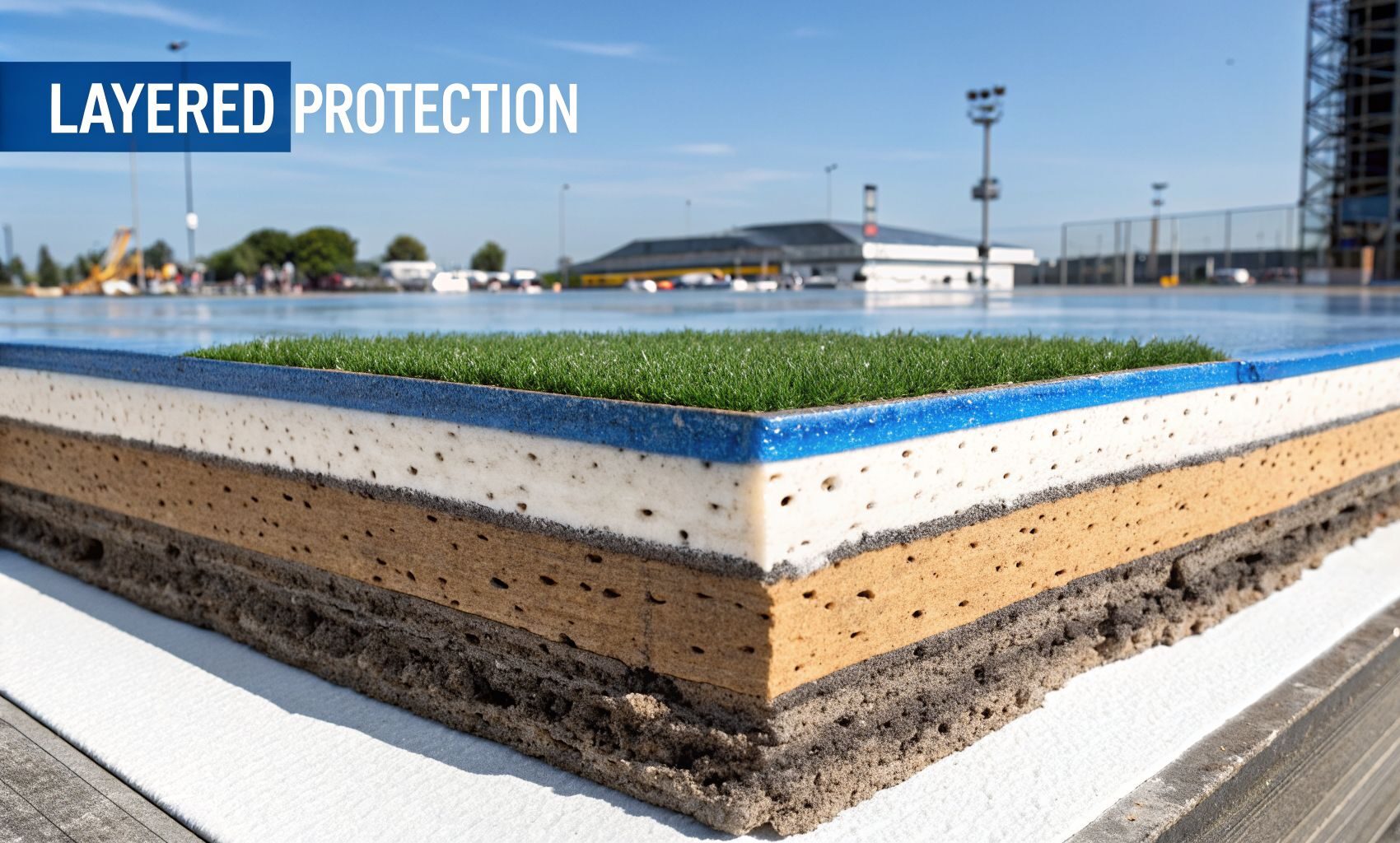
To understand what makes a polyaspartic floor so tough, you have to look at how it’s built. It’s not about one magic material. The real secret is using the right industrial-grade materials in the right layers, creating a system that’s far more durable than just epoxy or any single-coat product.

Think of it like a high-end phone case. You have a tough outer shell to stop scratches and a softer inner layer to absorb the shock from a drop. Our hybrid flooring system works the same way—each layer has a specific job, and together, they deliver unbeatable protection.
A Hybrid System Engineered for the Real World
At Pristine, we don’t just slap down one coat and call it a day. That’s a recipe for failure. Instead, we build a multi-layer system designed for maximum adhesion, durability, and a look that won’t quit.
It all starts with our 100% solids, moisture-blocking epoxy base coat. We use epoxy as the foundation for one critical reason: it has an incredible ability to seep deep into the pores of properly ground concrete, creating a bond that’s practically permanent. We do not skimp on our epoxy pour, ensuring this layer acts as a powerful primer, grabbing onto the concrete and blocking any moisture trying to push its way up—a common reason other floors peel and fail.
With the epoxy base still wet, we broadcast a thick layer of your chosen decorative flakes until the floor is completely covered. We call this a “full-flake broadcast,” not just a light sprinkle. This ensures a consistent, high-end look whether you choose flake, quartz, or solid color systems. After it cures, we scrape the surface smooth, preparing it for the game-changing final coat.
The Polyaspartic Topcoat: The Ultimate Shield
This is where the magic really happens. The final layer is a crystal-clear, industrial-grade polyaspartic topcoat. This isn’t just a sealer; it’s a high-performance shield with serious chemical advantages over older technologies.
- Incredible Abrasion Resistance: Polyaspartic chemistry creates a surface that’s more flexible and far less brittle than epoxy. That means it can take a hit from a dropped hammer or rolling toolbox without chipping or cracking. In fact, it has 2-3 times the abrasion resistance of traditional epoxy, standing up to years of heavy foot traffic and daily abuse.
- 100% UV Stability (No Yellowing. Ever.): Everyone’s seen an old epoxy floor that’s turned a nasty yellow from sun exposure. Our polyaspartic topcoat is 100% UV stable, so it will never amber or discolor, even in garages with the door wide open or on sun-drenched patios. This is non-negotiable for our local climate. Your floor’s color stays true, year after year. It’s also why we use these systems for our premium coating solutions for driveways, which bake in the sun all day.
The Pristine Standard isn’t a catchphrase; it’s our promise to use a scientifically better process. By combining a moisture-wicking epoxy base for an unbreakable bond and a tough-as-nails, UV-stable polyaspartic topcoat for durability, we build a floor that protects your concrete from the inside out.
This hybrid approach solves the weaknesses you get from using just one material. It’s the difference between a temporary paint job and a true, long-term flooring solution engineered for real-world performance. This is how we deliver a floor that not only looks incredible but stays that way.
Real-World Benefits of a Polyaspartic System
The science behind our coating system is impressive, but what really matters is how it performs in your day-to-day life. It’s one thing to understand the chemistry; it’s another to experience the practical benefits that change how you use your space. A professionally installed polyaspartic floor is more than just a shiny surface—it’s a significant upgrade that increases property value.

Maybe the biggest game-changer is how little it disrupts your routine. Thanks to the fast-curing chemistry, our one-day installation process means you get your space back almost instantly. Forget waiting a week for traditional epoxy to cure. A polyaspartic floor is ready for foot traffic in a few hours and for your car the very next day.
Built for Real Life and Low Maintenance
A Pristine floor is engineered to handle whatever you throw at it. That tough, flexible polyaspartic topcoat acts as a shield against all the typical garage hazards.
- Impact and Abrasion Resistance: Dropped a heavy tool? Dragged a storage bin across the floor? This surface is designed to absorb impacts and resist the scratches that would gouge or chip a lesser coating.
- Moisture and Stain Proof: The non-porous finish stops spills like oil, gasoline, or household chemicals from sinking in and leaving a permanent stain. They just bead up on the surface, ready for an easy cleanup.
- No Hot Tire Pickup: Go ahead and park your car after a long drive. Our coatings won’t soften, bubble, or peel from hot tires—a common failure point for DIY kits and cheap epoxy that is a total non-issue for our systems.
This resilience adds up to incredible long-term value. One of the standout features of a polyaspartic coating is its durability, boasting an average lifespan of over 20 years—often double that of standard epoxy. It’s because the unique chemical structure flexes under pressure, giving it 2-3 times the abrasion resistance of epoxy in lab tests.
A Smarter Choice for the Local Climate
Living in a sunny place with temperature swings brings its own set of challenges for any floor coating. This is where polyaspartics really pull ahead.
Our system is 100% UV stable, which means your garage floor, patio, or walkway won’t turn yellow, fade, or get brittle over time, even with constant exposure to intense UV rays. It’s a permanent finish that stays looking new.
Plus, it’s built to handle temperature fluctuations. The material expands and contracts right along with the concrete, preventing the cracking and delamination that often destroys rigid coatings during hot days and cool nights. It’s a floor built not just for your home, but for our specific environment.
Safety and Looks, Perfectly Combined
A beautiful floor is only great if it’s also safe. Our systems deliver on both. The decorative flakes we broadcast into the floor naturally create a textured, slip-resistant surface that provides excellent grip underfoot.
For areas that need even more traction—think pool decks, commercial kitchens, or sloped walkways—we can mix a specialized anti-slip aggregate directly into the topcoat. This adds serious grip without making the floor hard to clean or ruining its smooth look.
This combination of durability, safety, and almost zero maintenance is why our systems are the top choice for demanding environments. For a deeper dive, check out our guide on choosing the best flooring for high-traffic areas.
Ultimately, a professional polyaspartic floor isn’t just an expense; it’s an investment in your property. You’re not just buying a floor covering. You’re getting a functional, beautiful, and tough-as-nails asset that boosts your home’s value and gets rid of concrete headaches for decades to come.
The Pristine Process: How a Flawless Floor Comes to Life
A truly durable, head-turning floor doesn’t happen by accident. It’s the direct result of a painstaking, professional process where every single step is critical. A high-performance polyaspartic system is only as good as the surface preparation underneath it, which is why we’ve built our reputation on getting the foundation right.
Frankly, this is where most contractors fail. Let’s pull back the curtain on how a floor is supposed to be done, where cutting corners isn’t an option and a long-lasting finish is built in from the very first step.
It all starts with the single most important part of the entire job: surface preparation. We don’t just sweep the dust away and start rolling. Our in-house, expert crews use heavy-duty diamond grinders to mechanically profile your concrete, removing the weak top layer and opening up its pores. This creates a surface texture, almost like rough sandpaper, that gives our base coat something to bite into for an unbreakable bond.
Repairing the Foundation Before We Build
So, can our coatings be applied to damaged concrete? Absolutely—in fact, fixing your floor’s underlying issues is a non-negotiable part of our process. We never coat over problems like cracks, spalling, or pits. That just traps the problem underneath and guarantees failure down the road.
Our team hunts down and addresses every single imperfection. We use specialized tools to chase out cracks, clearing away any loose debris, before filling them with industrial-grade menders that actually cure to be stronger than the concrete around them. This creates a solid, stable foundation, ensuring the final surface is perfectly smooth and free of future issues.
A Multi-Layer System for Lasting Protection
With a perfectly prepped and repaired slab, the real transformation begins. This isn’t just about applying a coat of paint; it’s about building a robust, multi-layer system from the ground up.
-
Moisture-Blocking Epoxy Primer: First, we apply a 100% solids, moisture-vapor-blocking epoxy base coat. We don’t skimp here—this thick primer is worked deep into the concrete’s freshly opened pores. Its job is to form a vicious bond with the slab and, just as importantly, block any moisture trying to push its way up from below. This step alone prevents the #1 cause of coating failure: delamination.
-
Full Flake Broadcast: While that powerful epoxy is still wet and sticky, we broadcast a thick blanket of decorative vinyl flakes across the entire surface until the floor can’t hold any more—a technique called “broadcasting to rejection.” This guarantees 100% coverage and gives you that rich, premium, textured look. We have a huge variety of flake blends to choose from, so you can get the exact look you want.
-
The Bulletproof Polyaspartic Topcoat: Once the base coat has cured, we scrape the excess flakes to get a uniform, lightly textured surface. Then comes the final shield: a thick, crystal-clear, and 100% UV-stable polyaspartic topcoat. This is the layer that locks everything in, providing extreme resistance to abrasions, chemicals, and hot-tire pickup. Critically, it ensures your floor’s vibrant color will never yellow or fade, even in direct sunlight.
The Pristine Standard means using only premium, industrial-grade materials and our own highly trained, in-house crews—never subcontractors. This gives us complete control over quality from start to finish, ensuring every floor meets our exacting standards for durability and aesthetic value.
The result is a seamless, waterproof, and incredibly tough surface that completely transforms your garage, patio, or commercial space. This meticulous process, from grinding to topcoat, is how we can confidently deliver a floor that provides decades of performance.
Homeowner Checklist: Evaluating Your Concrete
Wondering if your floor is a good candidate? Just walk through this quick checklist.
- Cracks: Are there hairline fractures or wider cracks? These are common but absolutely must be professionally repaired before coating.
- Pitting or Spalling: Is the surface flaking, chipping, or showing little pockmarks? That’s a sign of weak concrete that needs to be ground away and patched.
- Stains: Do you have deep-set oil stains, rust marks, or other chemical spills? Diamond grinding is the only way to remove that contaminated layer for good.
- Previous Coatings: Is there an old, peeling coat of paint or a failing DIY epoxy kit on the floor now? It has to be completely removed before any new system can bond properly.
If you checked any of these boxes, don’t worry—your floor is the perfect candidate for professional restoration. Our process is designed to solve these exact problems, leaving you with a brand-new surface that is far stronger and more durable than the original concrete ever was.
How To Keep Your Polyaspartic Floor Looking Brand New
One of the best things about a professionally installed polyaspartic floor is how ridiculously easy it is to maintain. But let’s be clear: low maintenance doesn’t mean no maintenance. A little bit of care will keep your investment looking incredible for decades, protecting your property’s value and appeal.
The great news is that cleanup is a total breeze. Because we create a seamless, non-porous surface, things like dirt, dust, and even oil spills can’t soak in. Stains just don’t happen.
Simple Care for a Pristine Finish
For daily upkeep, a quick sweep with a soft-bristle broom or a dust mop is usually all it takes to handle loose dirt. When you need a deeper clean, you won’t need a shelf full of special products.
- What You’ll Need: Just a simple pH-neutral cleaner mixed with water. Use it with a microfiber mop, and you’ll get a perfect, streak-free shine without ever damaging the topcoat.
- What to Skip: Stay away from acidic cleaners or soap-based detergents. They can leave behind a hazy film and dull the finish. You also don’t need abrasive scrubbers or scouring pads—the tough topcoat makes harsh chemicals and aggressive scrubbing totally unnecessary.
If you have a spill, whether it’s a drink or motor oil, just wipe it up with a paper towel. You’ll see the liquid bead right on the surface instead of soaking in. That’s your coating protecting the concrete underneath from damage.
Protecting Your Floor From Heavy-Duty Use
Your floor is built to be tough and can handle common impacts like dropped tools without a problem. But even the toughest surfaces have their limits, especially when it comes to extreme, focused pressure.
If you’re using car jacks, just slide a piece of plywood or a sturdy mat under the jack stands. This simple step helps distribute the weight evenly, preventing a single pressure point from testing the coating’s limits. It’s a small habit that makes a big difference.
The infographic below shows the professional application that makes this durability possible. It’s this meticulous process that creates the tough, easy-to-clean floor you’ll enjoy for years.

Understanding how we build the system from the ground up—from diamond grinding to the final protective topcoat—shows why professional work is the only way to get a floor that truly lasts.
Is Your Concrete Ready for a Real Upgrade?
Take a quick look at your current floor. If you see any of these issues, you’re a perfect candidate for a professional coating that solves these problems for good.
- Cracks: Are there hairline fractures or bigger, more concerning cracks?
- Pitting & Flaking: Is the surface pockmarked or flaking away (a problem known as spalling)?
- Stubborn Stains: Do you have old oil or rust stains that refuse to budge?
- Failing Coating: Is there an old DIY epoxy kit or paint job that’s peeling, chipping, or bubbling up?
If you nodded “yes” to any of those, we can help. Our Pristine Process is designed to fix these exact issues, creating a brand new surface that’s stronger, tougher, and looks infinitely better than bare concrete ever could.
Your Questions About Polyaspartic Coatings, Answered
Even after seeing how great these floors look, you probably still have some practical questions. That’s smart. A new floor is a big investment, and you deserve to have all the facts.
We get asked these questions all the time, so we’ve put together some straight, no-nonsense answers based on our years of experience installing these floors in local homes and businesses.
How Long Does a Polyaspartic Floor Installation Really Take?
This is where polyaspartic floors really shine. For a typical residential garage, we can complete the entire job—from grinding the concrete to applying the final topcoat—in just one day.
The chemistry behind these coatings is what makes this speed possible. Your new floor will be ready for you to walk on in just 4-6 hours after we finish, and you can park your car on it within 24 hours.
Compare that to traditional epoxy systems, which can take 3-5 days to install and another full week to cure before they can handle vehicle traffic. Our one-day process gets your space back with minimal disruption.
Can Polyaspartic Coatings Be Applied to Damaged Concrete?
Yes, and addressing damage is a critical part of our professional process. Covering up problems like cracks or spalling is a recipe for failure. It just traps the issue underneath and guarantees your new coating will peel or delaminate down the road. That’s not how we do things.
Fixing the underlying concrete is a non-negotiable part of the Pristine Process. Our crews are trained to handle all sorts of concrete damage before a single drop of coating is applied.
- Crack Repair: We don’t just patch over cracks. We use specialized grinders to chase them out, clearing away any loose debris. Then we fill them with an industrial-grade mender that actually cures stronger than the concrete around it.
- Spalling and Pitting Repair: For flaky or pitted spots, we grind the area down to a solid foundation and patch it perfectly smooth.
Once the repairs are done, our heavy-duty diamond grinders go over the entire floor. This step profiles the surface, creating a unified foundation that ensures the coating grabs on and doesn’t let go. So, yes, we work with damaged concrete—we restore its integrity first, then we protect it for good.
What Is the Maintenance Like for a Polyaspartic Floor?
It couldn’t be easier. One of the biggest practical benefits of a polyaspartic coating is its seamless, non-porous surface. Dirt, oil, and grime sit on top instead of soaking in, making cleanup incredibly simple.
Most of the time, a quick sweep with a dust mop or soft-bristle broom is all it takes. For a deeper clean, a microfiber mop with a bit of pH-neutral cleaner and water will make it look brand new.
Maintenance Tip: Stay away from acidic or soap-based cleaners (like Pine-Sol or Fabuloso). They won’t harm the tough polyaspartic topcoat, but they can leave a dull, hazy film over time. The floor is so resilient that harsh chemicals are completely unnecessary.
Are Polyaspartic Floors Slippery When Wet?
While the high-gloss finish looks incredibly smooth, we build our floors with safety in mind. Our most popular full-flake systems already have a subtle, built-in texture from the vinyl chips, which provides a solid amount of slip-resistance.
For areas that see a lot of moisture or require extra traction—like commercial kitchens, walkways, or pool decks—we add an anti-slip polymer aggregate into the final topcoat. This is a very fine, almost invisible material that dramatically increases grip without changing the floor’s look or making it harder to clean. We can adjust the amount of anti-slip to get the perfect balance of safety and style for your space. To see how custom additions like this can affect the price, you can explore the factors influencing polyaspartic floor coating cost in our detailed guide.
How Does the Coating Handle Our Local Climate?
Polyaspartic systems are practically tailor-made for our local climate, thanks to two key chemical advantages: UV stability and flexibility.
- UV Stability: Our polyaspartic topcoats are 100% UV stable. This is a huge deal. It means they won’t turn yellow, fade, or become brittle when exposed to sunlight. It’s perfect for garages where the door stays open, patios, or any business with big, sun-facing windows.
- Flexibility: This material has more give than rigid epoxy. It can expand and contract with the concrete as temperatures shift from a cool night to a hot day, preventing the cracking and delamination that plagues lesser coatings.
This modern chemistry allows polyaspartic floors to cure enough for vehicle traffic in just 24 hours—a massive improvement over epoxy’s typical week-long wait. Developed in the 1990s, these advanced formulas have a working time of up to 45 minutes, allowing for a flawless, professional roll-on application. Real-world tests show they maintain 100% color fidelity and 95% gloss retention even after 10 years of direct sun exposure.
It’s a system built to perform exceptionally well right here in our sunny environment, making it a smart, lasting investment for any local property.